Sunday, February 26, 2012

Forager's Choice Muesli


My favorite muesli
Breakfast has always been my meal. I almost never go out for it, and nobody makes it for me.  It is a chance to eat exactly what I want, how I want it.  I think a lot of people feel the same way about the coffee that they drink (but I don’t drink coffee).  Like brushing my teeth, bathing, and getting dressed, breakfast is part of my morning routine that I approach in a way that reflects who I am.  So it is no wonder that I often prepare this meal as efficiently as possible, using ingredients that are either conspicuously inexpensive and/or extravagantly wild.  Like most humans, I go through fads, and my breakfast meals are no exception.  My favorite breakfast dishes are pancakes with maple syrup, breakfast burritos, Northern Gold granola, muesli, and smoothies but I don’t rotate through these in any systematic way.  Rather, I dwell on one for months at a time and then randomly switch to another. 

Lately I have been on a forager’s choice muesli kick.  The recipe is simple:
     1 cup rolled oats
     ¼ cup apple sauce
     ¼ cup elderberry pulp
     4 chopped dates
Add water, let sit until the oats get soft, and enjoy.

Wild Berry Smoothie
Chinese Hawthorn Fruit Leather
A few days ago I discovered some berries that I hid in Dad’s freezer, so I am on the verge of switching over to smoothies.  I posted my favorite smoothie recipe last month.  I also found some frozen Chinese Hawthorn(Crataegus pinnatifida) pulp that Katrina and I made from street trees in Victoria.  Last night we made some Hawthorn fruit leather which turned out exceptionally well.
Pin It submit to reddit

Saturday, February 25, 2012

Incipient Spring Nibbles


The basal rosette of Siberian Miner's Lettuce (Claytonia siberica)
Snow is forecast for tomorrow and the foothills are already dusted with white, but the first spring greens are starting to emerge in spite of the weather report.  Today, while on a moss hike with the WA Native Plant Society in the Chuckanut Mountains, I snagged some tender leaves of a few of our first incipient greens: Siberian Miner’s Lettuce (Claytonia siberica), Pacific Waterleaf (Hydrophyllum tenuipes) and Wall Lettuce (Lactuca muralis).  Siberian Miner's lettuce forms a basal rosette of leaves that occasionally survive the dry summer and cool moist winter.  More commonly the plants have an annual life history whereby they germinate in the fall and persist through the winter with only their cotyledon leaf and then grow like gangbusters in early spring. Today I noticed that the cotyledon leaves have widened into an egg shape and will soon begin to develop a basal rosette.  I nibbled a few of both the cotyledon leaves and the surviving rosette leaves from last years growth.  They were tender, juicy, and agreeable.  I find Siberian Miner’s Lettuce leaves to be tasty throughout the spring until the plant starts to flower, at which time they take on a sharp tang that burns the back of my throat.  There is another species of Miner’s Lettuce (C. perfoliata) with a similar range and growth form, but unfortunately isn’t as common around Bellingham.  In my opinion, Claytonia perfoliata is the NW’s superlative green, it is juicy like spinach, mild tasting, and doesn’t take on the burning quality of C. siberica.  It is still too early to bother harvesting miner’s lettuce, but it was fun to have a nibble.

The leaves of Pacific Waterleaf (Hydrophyllum tenuipes) ready for harvesting
The harvest season for Pacific Waterleaf, however, looks to be just starting.  In other parts of the country Waterleafs form an important part of a guild of plants known as “spring ephemerals,” and are commonly know by foragers, but here in the NW, our two species (H. tenuipes and H. fendleri) are inconspicuous, esoteric, and not very abundant.  Their edibility is also little known.  Erna Gunther documented the use of H. tenuipes rhizomes by the Cowlitz (See Ethnobotany of Western Washington in my Google Books Library) but I could find no other literature on the use of Waterleafs by NW Coast Indigenous Peoples.  I find the leaves to have a pleasant flavor but it may take a while to get used to their fuzziness.  The leaves would probably be served better as a cooked green, but I haven’t experimented with that yet.  I aim to devote a little more attention to my fuzzy little vegetable next week and try both the leaves and the roots.

Young leaves of Wall Lettuce (Lactuca muralis)
The trails throughout the Chuckanut Mountains are strewn with Wall Lettuce, a weedy member of the same genus as the lettuce available at the grocery store.  I typically find Wall Lettuce too bitter to enjoy, but young leaves that I tried today were not overly bitter and would be good mixed with Miner's Lettuce in a salad.  As we were leaving I noticed a few Stinging Nettles (Urtica dioica) poking through the detritus.  They are much too young to bother harvesting, but I couldn’t help but acknowledge another one of my favorite spring vegetables.

A cute but well armored sprout of Stinging Nettle (Urtica dioica)

Pin It submit to reddit

Thursday, February 16, 2012

Catkins, can we eat them?


Catkins of Western Birch (Betula papyrifera var. commutata)
After following a string of notes about the edibility of birch catkins on the Forageahead list-serve I decided to see what ethnobotanical literature and a little experimentation could teach me.  Catkins are an important springtime food for several species of birds, but can humans eat them? 

Daniel Moerman’s book Native American Food Plants contains several accounts of edible catkins in the desert SW.  The young pistillate catkins of Fremont Cottonwood (Populus fremontii) were eaten by the Acoma, Isleta, Jemez, and Navajo; Rio Grande Cottonwood (Populus deltoides ssp. wislizenii) catkins were chewed on like gum by the Pima and Havasupai; the Pima also ate the pistillate catkins from both Screwbean Mesquite (Prosopis pubescens) and Goodding’s Willow (Salix gooddingii). 

Ray Vizgirdas and Edna Rey-Vizgiradas wrote in their book Wild Plants of the Sierra Nevada that staminate catkins from White Alder (Alnus rhombifolia) and Mountain Alder (A. incana) are edible and high in protein but do not taste very good.  Further north, on the Coast of British Columbia, Harriet Kuhnlein and Nancy Turner reported in Traditional Plant Foods of Canadian Indigenous Peoples that the green staminate catkins of Red Alder (A. rubra) were eaten by the Straits Salish.

Anecdotes from the wild food community include the late wild food enthusiast Storm, who published a very detailed experiment with Red Alder catkins here.  Storm ate Red Alder catkins every day for 10 days with no ill effects.  He experimented gathering the pollen as well.  Greg Tilford reported on Red Alder catkins in his book Edible and Medicinal Plants of the West saying that they are edible and high in protein, but best left as survival food since they don’t taste very good.

Today I went on a short walk through an urban area in Bellingham and picked staminate catkins from 4 members of the Birch Family: Hazelnut (Corylus avellana), Western Paper Birch (Betula papyrifera var. commutata), European White Birch (Betula pendula), and Red Alder (Alnus rubra).  The Hazelnut and Western Paper Birch catkins were already releasing pollen, the Red Alder will probably release pollen in a week or 2, and the European White Birch in 2-3 weeks.  Katrina and I sampled catkins from each species both raw and cooked.


Catkins of Red Alder, Western Paper Birch, European White Birch, and Hazelnut (from left to right)

Hazelnut (Corylus avellana) catkins
The Hazelnut catkins grow in clusters of 1-3 that hang throughout all the smaller branches.  Catkins are 2-4 inches long and relatively soft and flexible.  Raw, they had a texture like dry sawdust and a mild, bitter flavor.  Boiling for 5 minutes in salted water improved the texture to that of wet sawdust and mellowed the flavor.  They were not disagreeable and we found that the catkins with more developed flowers to had a better taste.


European White Birch (Betula pendula) catkins
The European White Birch catkins also grow in clusters of 1-3 at the tips of very slender, drooping branches.  At ¾-1 ½ inches long, the catkins are smaller and more firm than the Hazelnut catkins (though they are less phenologically advanced).  We found the raw catkins to have a crunchy texture with a bitter, piney flavor.  Cooking slightly softened the catkins, but increased the bitterness and gave them the taste of leaves or sap.

Western Paper Birch catkins
The Western Birch catkins grow singly from multiple points along the previous year’s new growth.  Catkins are 1 ½-2 ½ inches long, soft, and flexible.  Their flavor raw was astringent and piney, but less intense than the European White Birch.  Boiling produced and aroma like grass or peas and darkened the water to a greenish yellow.  The cooked catkins tasted more bitter than the raw catkins.


Red Alder (Alnus rubra) catkins
Our final taste test was of Red Alder.  Catkins are 1 ½-3 inches long, hard, dark green to reddish, and arising in terminal clusters of 2-5.  The raw catkins had an acrid, fir needle taste with an astringent after taste.  They exploded in the boiling water releasing their pollen and a mildly sweet aroma akin to sap and boiled nettles.  The cooked catkins were very resinous and had a milder flavor than the raw catkins.
Boiled catkins on a plate ready for taste testing

At this juncture, I would have to agree with Tilford in categorizing catkins as survival food.  However, I can hardly expect that my first experiment with a little known food would yield incredible results.  I will continue to taste these catkins throughout their development and in the years to come, and perhaps time and experience will unlock the grouse’s secret to making the most of catkins.

Please note that I have included a link to my ethnobotany and wild food digital library on the right hand site of this webpage (near the top) for those of you that want to check out the books that I referenced.
Pin It submit to reddit

Sunday, February 12, 2012

Arrowhead- a belated homage to Chinese New Year

Tubers of Arrowhead (Sagittaria sagittifolia) a close relative of our Wapato (Sagittaria laitoflia)

Arrowhead being cultivated in China
Every year I look forward to the Chinese New Year with a little more anticipation than our Gregorian Calendar based celebration of New Year’s Eve.  While some of our traditions resonate with me (kissing, resolutions, and singing about friendship), I find the drunken debauchery and fireworks unappealing.  I also sense that most people have forsaken traditional feasting on New Year’s Day for chips and television.   The Chinese tradition of bringing the New Year in with cultivated native foods and feasting is what attracts me to their version of the Holiday.  Cured duck, fish, preserved fruits, and wintertime vegetables are featured during family feasts, and a close relative of my favorite wild root vegetable—Wapato (Sagittaria latifolia)—is imported to Chinatowns across America for the occasion.  Called Chi Gu (“benevolent mushroom") in Chinese, and Arrowhead (Sagittaria sagittifolia) in English, the tubers are grown by the Chinese in shallow ponds.  When I was in China in 2009, I saw a few small Arrowhead patches.

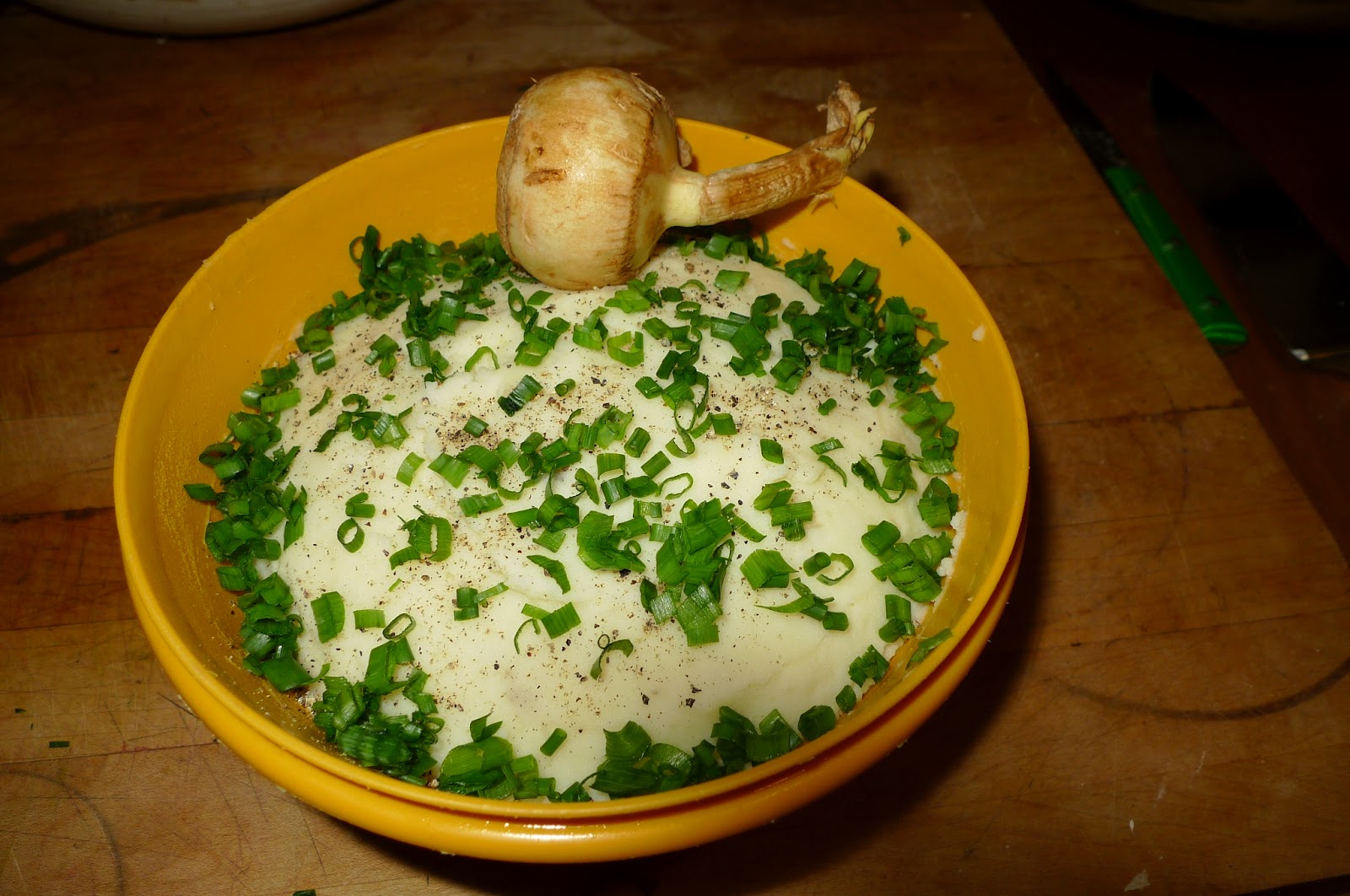
Garnished with a benevolent mushroom
Last week in Seattle I was lucky enough to find a grocer in Chinatown that still had some Arrowhead in stock.  I purchased as much as I could carry and Katrina and I prepared a dish featuring the mashed starchy tubers for a potluck.  We peeled about a dozen tubers and boiled them for 10 minutes.  Then we mashed them with a tablespoon of olive oil, and a half cup of coconut milk, and seasoned them with sea salt, cracked black pepper, and diced chives.  For garnish we placed an unpeeled tuber on our mountain of mashed Arrowhead.

Both Arrowhead and Wapato have a flavor that is starchy, sweet, and mildly fruity.  Their texture is very similar to Potatoes, perhaps a little drier and grainier.  I often compare their flavor to a mixture of sweet corn and Potatoes with a hint of grapefruit.
Pin It submit to reddit

Tuesday, February 7, 2012

A Taste of Fall


Over the last few weeks Katrina and I have been benefitting from the fruits of our autumn labors.  Processing and leaching acorns has become a weekly ritual and we have been enjoying our canned, frozen, dried, and fermented fruits.  Today I finished leaching another batch of Garry Oak (Quercus garryana) acorns.  I saved the leaching water each day after I poured it off so that I could compare the water color over the course of the 6 changes of water.  As you can see, the water from the 1st day is significantly darker than the 2nd day, which in turn is significantly darker than the 3rd.  Thereafter, however, the difference is barely perceptible.  For the last 3 months I have been grinding my acorns with a Vitamix instead of my old pathetic blender and the Vitamix is producing finer flour.  I was in the habit of leaching for 5 or 6 days, but that might not be necessary anymore.  Based on the color of my leaching water, I will experiment with only three changes of water next time. 

Acorn bread cooking
After months of enjoying the ease of dry-grinding acorns with the Vitamix, today I decided to mix things up a bit and experimented with wet-grinding acorns.  When I was dry-grinding acorns the flour would heat up and get clumpy, preventing the flour from freely circulating throughout the blender container.  Not only was this keeping me from getting a really fine grind, I think that prematurely heating the acorns may have caused the oils to leach out more easily, damaging both flavor and nutrition of the final product.  Today when I used water while grinding acorns, I created a suspension of acorn flour and grit.  I noticed that in this suspension it was easier for the large particles of acorn grit to settle through the acorn flour to the bottom of the mixer where they were pulverized by the spinning blade.  Water also keeps the flour nice and cool throughout the grinding process.


These past few weeks I have also put the blender to work making delicious wild berry smoothies that are a perfect balance of creamy, sweet, tart, and chewy.  If you have never had a chewy smoothie, you’ve got to try it.  Here is the recipe for my new favorite smoothie:
1 Banana (for creaminess)
 ¾ cup frozen Evergreen Huckleberries (Vaccinium ovatum)
¼ cup dried Salal (Gaultheria shallon) berries (for chewiness)
¼ cup water
1 heaping tablespoon Blue Elderberry (Sambucus caerulea) jelly
If you don't have Salal, try substituting dried blueberries or cranberries.

Canned Crabapples (Malus fusca) and Crabapple cider
We recently cracked open our first quart of this year’s Crabapples (Malus fusca).  After several months resting in very light syrup, I found the sourness of the Crabapples had mellowed to a pleasant pucker.  We sucked them right off the stems like applesauce popsicles.  A few days ago Katrina bottled some cider that she made with a mixture of Crabapple juice and apple cider that we pressed last fall.

Katrina working her magic

Pin It submit to reddit

Sunday, January 8, 2012

Yosemite


Half Dome

The Sierra Nevada dawned brightly on the western horizon as I rubbed the slumber from my eyes and stumbled out of the tent to watch the sky transition from darkness to light.  Our trip was also about to change.  Today would be our last day of exploration before we would have to drive hard for the motherland.  Today was also going to be a special day, because we were transitioning out of Mary Austin’s “Land of Little Rain” and into John Muir’s “Treasure of the Yosemite.”  For the first time in my life, I would literally follow in the footsteps of a guide whose spiritual path I have long traveled.  Like a similar pilgrimage around Walden a decade earlier, we climbed into the Sierra with hearts as open as our eyes.  If only I had weeks instead of hours….

"Waving onward in graceful compliance"
Trees! Their increasing diversity greeted us as we gained altitude and crossed the impossibly high 9,943 ft. Tioga Pass.  We stopped to look for Whitebark Pines (Pinus albicaulis), yet another large seeded species and, as if on cue, a Clark’s Nutcracker flew across our path revealing none of its secret knowledge of all the best pine nuts.  Gnarled trees atop granite monoliths splayed their branches to the mountain winds; as Muir so poetically characterized, they were “waving onward in graceful compliance.”  We descended into the park and the tree diversity continued to increase.  The variety of pines alone was astounding.  We saw Lodgepole (P. contorta ssp. murrayana), Western White (P. monticola), and Jeffrey Pine (P. jeffreyi) in the rocky subalpine, and Sugar (P. lambertiana), Ponderosa (P. ponderosa), and Grey Pine (P. sabiniana) on the lower elevation valley walls.  Red Fir (Abies magnifica) and White Fir (A. concolor) were also common and there was even a smattering of Douglas Fir (Psuedotsuga menziesii).  Being from cedar country, I was excited to see immense stands of Incense Cedar (Calocedrus decurrens), which has always been a novel tree to me.  John Muir’s discussion of the Sierra's trees can be found here.

Small examples of Black Oak (Qerucs kellogii) acorns
While we were in the subalpine, I kept complaining to Katrina about how choked the forests seemed with “dog-hair” stands of pine, which I expect was historically burned by the Native Americans to create a more open landscape that favored higher plant diversity.  Near the valley bottom I was surprised to see a large area of burned forest.  The park has started to embrace fire as a management tool.  We began to see Black Oak (Quercus kelloggii) and Canyon Live Oak (Q. chrysolepis) with increasing frequency.  Both of these species were important food resources for the Native Americans living in the valley and are more fire resistant than pine.  In the low elevation foothills outside of the park near Mariposa CA, I made my final collection of acorns from Interior Live Oak (Q. wislizenii) and Blue Oak (Q. douglasii).  

With a setting sun on the horizon, we bid adieu to Yosemite, the Sierras, and the distant landscapes that taught us so much about the wild foods of the Desert SW.  Our backs had grown accustomed to sleeping on the soil-less earth, and our skin, to the bright sun;  Our minds were full of new ideas, and our trunk was filled with acorns and salt.  We couldn’t have asked for a better winter holiday.  Leaving our last backroad and turning onto the highway, we set a course for home.  The coming months will be quiet ones for harvesting in the Pacific Northwest, but I look forward to experimenting with the many varieties of acorns that we picked on this trip and opening the larder for regular doses of the more fruitful month’s fare.
Pin It submit to reddit

Saturday, January 7, 2012

Death Valley


Cottonball
Death Valley is an elemental land made sensuous by simple combinations.  From a broad view, parched earth, scoured canyon walls, and blue sky combine to elevate the soul in an impossibly low landscape.  Crouch down for a closer look and dazzlingly small crystals of two more basic elements conspire to tickle the light and tease the tongue.  We came to Death Valley to explore its salts and quickly learned that Death Valley was a sophisticated laboratory precipitating many different combinations of elements.  Sodium borate, or borax is probably the Valley’s best known mineral, made famous by the “20 mule team” (actually 18 mules and 2 horses) that was used to haul the versatile mineral 165 miles across the Mojave Desert to the nearest railroad.  Borax is used in detergents (as a water softener), and metallurgy, and glasswork (as a hardener!).  The glass in the 200” Hale Telescope wasn’t successfully cast until the engineers tried Pyrex, which has borax in it.  Many other mineral salts, some with very colorful crystals can be seen in the Borax Museum next to the Visitor Center.  Most of the Borax in Death Valley was mined and then refined, but surface deposits of cottonball—a mixture of borax, salt, and dirt—can be seen near the Harmony Borax Works.  

Katrina on the hunt for a glimpse of the elusive salt
Katrina and I were mostly interested in sodium chloride, a mineral that Mark Kurlansky proclaims in his book Salt, a world history to be “the only edible rock.”  The flats in Badwater Basin are coated with large crusts of salt.  Runoff from the sorrounding slopes and the valley's meager 2 inches of annual rainfall washes minerals down the steep valley walls where it is trapped in the deep basin.  Cloudless skies and scorching temperatures (often over 120 degrees F in the summer) quickly evaporate the water leaving behind a 95 percent pure salt.  We walked a trail out onto the expansive white salt flat and I caught Katrina licking the ground a few times.

Mark Bitterman, another salt enthusiast, provides some useful historical perspective on salt in his book Salted, a Manifesto on the World's Most Essential Mineral.  He writes, “For most of human existence salt has been scarce… difficult to transport and of dramatically varying quality.  Salt was, literally, a treasure, and everyone everywhere who could make it would.  Yet salt making was a challenging, physically demanding, risky job requiring the participation of an entire community.  The salts that resulted were unique, each bearing a mineral and crystalline imprint of the elemental and human forces that wrought it.  Salt was a natural, whole food, intimately tied to a place and a way of life.”

Joseph flint knapping
I spent much of the day at a flint knapping demonstration by Joseph Moore, a retired archaeologist.  He used elk and stone tools to flake obsidian into beautiful arrow heads.  He is also an avid birder and forager with a lot of  knowledge about the regionally available plant resources (basically a great guy), so I picked his brains about Pine Nuts and Honey Mesquite (Prosopis glanulosa) beans.  Neither are in season, but it would be fun to make another trip to the Desert SW when they are. 

We then drove northwest out of the valley towards Yosemite.  The higher elevation passes were covered with Single-leaved Pinyon (Pinus monopylla) and we stopped to investigate, but none of the nuts we found were any good.  Joseph said that this was a poor productivity year, and it was too late in the year anyway.
The robust needles of Single-leaved Pinyon
These large Pine Nuts are empty


We descended into the Owen's Lake Valley and made a brief stop to collect a little salt in the fading light.  There were birds everywhere, but not enough light to see them.  We found a nice piece of desert near Bishop to set up our tent (too cold and windy for sleeping out).

Camp Bishop
Pin It submit to reddit

Friday, January 6, 2012

Ruins


Kelso Dunes
The next day we entered the eerily empty Mohave National Preserve and climbed up the “singing sand dunes.”  The Kelso Dunes are made up of ultrafine sand that produces a low humming noise when they move.  We were pretty sure we heard them sing once.  The dunes are so steep and the sand so loose in places that it is almost impossible to climb straight up them.

A small hole in the wall
The central part of the Preserve is mountainous and we drove a very rough road around to the Hole in the Wall campground.  We explored the narrow canyon and deemed it free of bandits (they live in Wyoming with the Sundance Kid) and enjoyed a little botanizing as the desert vegetation was starting to become familiar.

In the afternoon we drove east out of California and along parts of the historic Route 66.  When we crossed into Arizona we started climbing steadily out of the desert and into high pine country.  We were trying to get to the Grand Canyon in time to see the sunset but only arrived on the snowy South Rim for the final cool hues of twilight.

Camping that night in the Kaibab National Forest was the coldest of the trip.  Even though we set up the tent to provide a little extra insulation, I had to get up and light a fire in the pre-dawn hours to warm up.  At least firewood was easier to come by than in the desert.


Colorado Pinyon silhouette
Gambel Oak leaf (Quercus gambelii)
We went back to the South Rim to watch the sunrise and then hiked along the rim and watched the Mt. Chickadees, Nuthatches, and Western Scrub Jays flit about the Colorado Pinyon (Pinus edulis), Utah Juniper (Juniperus osteosperma) and occasional Gambel Oak (Quercus gambelii).  I saw some acorn caps, but all the acorns must have already been stowed away by the animals.  We went to a talk about the Tusayan Ruin in the park, and after some correspondence about Pueblo acorn use learned from Park Archeologist Ian Hough that “the Gamble oaks found in the park do not produce the type and quantity of acorns found in California or east of the Mississippi, where mortar and pestle technology was much more developed. But acorns and many other wild plant foods were processed and eaten here at Grand Canyon and accounts for various other forms of grinding tools that we find.”  The Pueblo that inhabited the ruin site 800 years ago relied more heavily on maize, beans, and squash.
Colorado Pinyon (Pinus edulis) needles in bunches of two

We found the ruins fascinating and learned that the nearby Wupatki National Monument managed several more ruins, so we spent the rest of the afternoon exploring them.  Nobody knows for certain why the settlements were abandoned, but I couldn’t help but wonder if they ran out of firewood.


Our next stop was Death Valley which was several hundred miles away, so we tried to get some of the driving out of the way that night and camped in the desert near Chloride AZ.  The next day we took much needed baths in Lake Mead, and pressed on to Death Valley for some more salt reconnaissance. Pin It submit to reddit

Tuesday, January 3, 2012

Joshua Tree


Quilted Sunrise
Our Camp next to Little Box Canyon
The sunrise this morning was exquisite.  The sky was quilted with pink and orange which gave the bare canyon walls a warm glow.  We packed up early and drove the few remaining miles to Joshua tree.  Katrina went for a run and I explored the park a little on my own.  The Live Oak picnic area caught my attention and I was surprised to find a full sized oak in such an arid park.  I am uncertain exactly what kind of oak it was, perhaps a Shrub Live Oak (Quercus turbinella) hybrid with Valley Oak (Q. lobata).  The leaves had pointy tipped lobes and the acorns were an even tan color, lacked any fuzz, and were 30-40 mm long and 14-18 mm wide.  The acorn caps were in clusters and had warty tops with short felted hairs.  The Barker Dam area has a number of Shrub Live Oaks, but they had already dropped all of their acorns, were much scrubbier, and didn’t have lobed leaves.  We also encountered Single Leaved Pinyon (Pinus monophylla), which is a scrubby little pine tree with robust needles in clusters of… 1.  I never knew there were any one needled pines.  We played around on the rocks, photographed the shapely boulders, and jealously watched climbers (I wish I had brought my climbing shoes).

Shrub Live Oak hybrid (Quercus turbinella x lobata)

Shrub Live Oak hybrid (Quercus turbinella x lobata) acorns


Katrina in her element(s)

We wanted to find a quieter place to camp, so we left the park before sunset and drove north towards the Mojave National Preserve.  Just after the sunset we past the expansive salt flats at Bristol Lake and stopped to collect a few of the massive salt crusts.  You can see Katrina was pretty happy about it.  We continued east a little further until we found another flat chunk of desert to tie up our horse and poke at the fire while our can of beans cooked.
Pin It submit to reddit

Monday, January 2, 2012

The Salton Sea


Female Phainopepla
We got up with the sun this morning and drove over to the Yaqui Well to get a little desert birding in before heading to the Salton Sea.  As we climbed back into the mountains we spotted a group of Borrego, or Big Horn Sheep cruising along the rocky terrain and got a good look at them before they passed out of sight.  They are magnificent animals!  At Yaqui Well we spotted several Phainopeplas, and went for a short hike through bizarre plants like Ocotillo (Fouquieria splendens) and Barrel Cactus (Ferocactus cylindraceus).

Ocotillo

Barrel Cactus
Katrina was antsy to hunt for some wild edible minerals (and the birding wasn’t all that good in the desert), so we drove east to the Salton Sea where we were immediately greeted by an abundance of both salt and birds.  If it wasn’t 60 degrees out, I would have thought that the shores were lined with snow that had drifted into all the low spots, such was the color and abundance of salt.  We learned that the Salton Sea is much saltier than Ocean Water, and as the irrigation waters that feed the lake evaporate, the salinity continues to rise.  Apparently this is a conservation concern because some of the fish that live in the lake will soon be unable to tolerate the brine.  The Salton Sea is of major importance to migratory waterfowl, which rely on the abundance of fish.  The signs that informed us of this conservation pickle were kind of amusing because they insinuated that something could be done.  Katrina and I had a fun time imagining solutions to the evaporation problem and ultimately decided that the government should pay Katrina to remove salt from the water.  Ironically, the Salton Sea (California’s biggest lake) was formed in 1905 by an irrigation accident which diverted the entire flow of the Colorado River into the -227 foot below sea level basin for 18 months.  The Salton Sea isn’t without precedence though as Native American narratives tell of a time when an even larger lake filled the valley.

American Avocet
Salton Sea Sunset
The birding was exceptional.  Highlights included Sand Hill Cranes, White Faced Ibis, White Pelicans, American Avocets, Eared Grebes, Roadrunners, Abert’s Towhee, ducks of every description, and thousands of Ross’s Geese.  Our shadows stretched eastward before we packed away the binoculars and started driving north towards Joshua Tree National Park.  We took a shortcut on Box Canyon Road through the Mecca Hills and laid out our sleeping bags next to the Little Box Canyon trail for another wonderful night under the stars. 
Pin It submit to reddit