Wednesday, May 30, 2012

Balsamroot- the challenge continues

I am posting the results of another Balsamroot (Balsamorhiza sagittata) experiment.  My results aren't great, but I figured they might be useful to others so I am sharing them.

Materials: I harvested a few roots from the Methow Valley 2 weeks ago.  They were moderately sized (about 1 inch in diameter at the widest point) and from plants that were in flower, or about to flower.

Preparation: I removed the bark and steamed the roots for 2 hours in a pot.  I tested the roots and they were still very fibrous.  I put them in a pressure cooker and cooked them for another 4 hours.


Results: Tasting the roots was still akin to chewing on a hemp rope soaked in Cottonwood resin.  The flavor was nice, I just couldn't bring myself to swallow a mouthful that was 90 percent fiber.


Discussion:  I have yet to pit cook Balsamroots for 48 hours like was traditional, but I am loosing optimism that the tough fibers will soften into something edible.  The cooking water in the pressure cooker was milky from what appeared to be a carbohydrate like substance  Steamed and baked roots would probably not suffer the loss of these carbs.  I cooked the Balsamroot with the root of Fern-leaved Desert-parsely (Lomatium dissectum).  The Desert-parsely root took on the resinous flavor of Balsamroot, but was still too bitter for me to enjoy.  Balsamroot was traditionally cooked with other roots, and I am starting to wonder if it was used primarily as a flavoring, despite the plethora of ethnobotanical evidence that says Balsamroot itself was eaten.

Conclusion:  Try collecting 1/2 inch diameter Balsamroots in the spring before they flower and steaming them for 48 hours in my slow-cooker.

I would love to hear from anyone that has successfully eaten Balsamroot.


Pin It submit to reddit

Saturday, May 26, 2012

First Fruits! Salmonberries Sweetened by Song


A perfectly ripe Salmonberry (Rubus spectabilis)
I guess I’m not a very good mushroom hunter, or maybe I just get distracted too easily.  Early last week heavy rains and warm temperatures forced the Nooksack River over its banks in a few places and the last few days of sunshine got me thinking about mushrooms.  Katrina and I packed our baskets and headed out towards Everson to walk the sandy floodplain cottonwood forests in search of Morels.  The woods quickly swallowed us as we followed an overgrown dirt road that parallels the river.  Cottonwood fluff drifted through the bright shafts of light with such placid uniformity we felt like we were part of a gentle current underneath a kelp forest.  If mushrooms were there, we probably walked right over them because we had such a hard time keeping our eyes on the ground.  The calls of Robins, Townsend’s and Orange Crowned Warblers and a few exuberant Pacific Wrens provided further excuses to tune our attention upward.  That’s when we started to hear the unmistakable upward spiraling call of the Swainson’s Thrush. 

Cottonwood fluff, like snow, coated our path
Easily one of my favorite bird calls for its beauty alone, the music conjures smiles for another reason as well.  My mentor, Clan Chief Kwaxsistalla, loved to tell a story about the Swainson’s Thrush (Salmonberry Bird) who summoned the hungry and winter weary people of his village together for a feast and used nothing more than his beautiful call to ripen Salmonberries for his people to eat.

A feast fit for a thrush
Kwaxsistalla’s telling of the story has a magic about it that was well recalled amidst the drifting cottonwood fluff, wild rose scented air, singing birds, and… what’s that… ripe Salmonberries!  The further we ventured into the musical woods, the riper the Salmonberries got.  We picked without a care in the world and soon our baskets were filled with the glistening jewels.  Our mushroom hunt couldn’t have been better!

Salmonberries herald in the season of fruit, and while some may argue that they aren't the tastiest fruits of the year, I say that there is a lot of value in being the first.  And what do I have to compare them too?  Five long, rainy months have done a lot to sodden my memories of the last fresh fruit I ate, and several more since I ate Salmonberry's "tastier" cousins.  So in spite of the naysayers out there, I gladly break my seasonally imposed fruit fast on this colorful berry- sweetened (as I am) by the song of the Swainson's Thrush.


Pin It submit to reddit

Sunday, May 20, 2012

Garry Oak Gardening

Giant Camas in a restored meadow at Padden Lagoon, Bellingham
Late last fall Mom, Katrina, and I seeded several wonderfully edible Garry Oak Ecosystem species.  So far, the Garry Oaks (Quercus garryana), Miner's Lettuce (Claytonia perfoliata), Common Camas (Camassia quamash), and Giant Camas (C. leichtlinii) have all come up.  Garry Oaks are a strongly taprooted species and the roots had already made it down to the bottom of the pint-sized pots and started to circle around (which probably isn't too good for the trees).  Mom transferred them into 3-gallon pots where they will continue to grow until next year.  I want them to be large enough that we can put tubes around their trunks to protect the bark from voles, which often girdle trees planted in grassy fields.


The twisted tepals of Giant Camas (left) and disheveled tepals of Common Camas (right)

Starts of Miner's Lettuce (left), Common Camas (middle) and Giant Camas (right)
Our Miner's Lettuce germinated decently from seed.  It is almost done flowering now, so I wanted to get it transplanted someplace that it can reseed itself for next year.  I decided to plant the Miner's Lettuce in with normal garden vegetables so it can provide a winter cover crop.  Both the Common and Giant Camas germinated very well.  You can already tell them apart.  The grass-like leaves of the Giant Camas are twice as thick as the Common Camas.  Katrina and I planted the Camas in garden rows so that they can continue to grow until we are ready to establish a more permanent Garry Oak garden.

Acorn Bread
To celebrate, Katrina cooked up our first batch of leavened acorn bread.  She just substituted leached acorns for corn in a cornbread recipe (acorn flour, wheat flour, eggs, maple syrup, oil, baking powder, and homemade sea salt) and the result was phenominal!  I can't wait to share it with others.  It has a chocolate color like brownies with a rich, nutty flavor, soft fluffy texture, and NO bitterness.  I don't think I'll go back to flat bread for a while.
Pin It submit to reddit

Monday, May 14, 2012

Okanogan Roots: Mountain Potato, Glacier Lily, and more


What my friends planned to be a weekend Morel (Morchella sp.) foray in the Methow Valley turned into a timely harvest of a variety of root vegetables, many of which I have long wanted to try.  It wasn’t an intentional bait and switch, the Morels just weren’t out yet, and the roots were.

Glacier Lily (Erythronium grandiflorum)
We were still descending from Washington Pass near Mazama when I pulled the car off the road to “see about a plant.”  A glimmer of yellow caught my eye on a snowless north facing slope and I instantly knew it to be Glacier Lily (Erythronium grandiflorum).  They have a knack for springing up and brandishing their relatively large flowers as soon as the snow has melted.

Glacier Lilies were a staple root vegetable for the Blackfoot, Okanagan-Colville, Shuswap, and Thompson (See Native American Food Plants).  The roots (corms), were occasionally eaten raw, but more commonly steamed, boiled, or sun dried.  The raw corms were said by some to be inedible, and by others to not be as sweet as the dried roots.


Unearthed corms of Glacier Lily
My friends and I harvested a half dozen Glacier Lily corms by following the long tender flower stalks 3-5 inches into the damp soil.  I learned that they are easier to gather by starting a deep hole next to a good sized clump and then extending the hole sideways until the corms are visible.  Each corm has a delicate string like appendage that easily breaks off.  According to Dawn Lowen—who studied the nutritional chemistry, ethnobotany, and ecology of Glacier Lilies with Thompson elder Mary Thomas—these appendages are capable of regenerating into new plants and were carefully replanted to ensure future harvests.
  
Glacier Lily corm clean and ready to be eaten
Glacier Lily leaf
I found the raw corms to be amazingly sweet, which was corroborated by Lowen’s phytochemical analysis.  She measured sugar concentrations that peaked when the Glacier Lilies are flowering.  I also enjoyed the fresh flowering stalks and leaves, but I felt like the leaves were slightly acrid (more subtle than the raw leaves of Siberian Miner’s Lettuce or Curly Dock).  Cooking will likely improve the flavor of both the corms and leaves.  I transplanted several corms into my home-garden to propagate for further experimentation.

Several flowering stems on a large Mountain Potato
While tromping through recently burned forests looking for Morels, I came across the small succulent leaves and Miner’s Lettuce-like flowers of another long anticipated wild food -- Mountain Potato.  Mountain Potato (Claytonia lanceolata) is actually a close relative of Miner’s Lettuce (C. perfoliata), but instead of having the spindly roots of an annual, Mountain Potato has a pea to cherry sized starchy tuber that persists from year to year.

Mountain Potatoes were traditionally eaten by the same people that ate Glacier Lilies.  They were consumed fresh or boiled and often stored fresh in large quantities for use during the winter (See Native American Food Plants).  For further reading, also read Carla Mellott's superb Master’s Thesis on the ‘Tsilhqot’in ethnobotany and ecology of Mountain Potato.

A medium sized Mountain Potato (Claytonia lanceolata)
Unlike many root vegetables in the interior, Mountain Potatoes are relatively easy to harvest.  The tubers are only 1-2 inches below the surface and they often grow from underneath rocks, which can simply be picked up to reveal the tubers.  Depending on the elevation, the specimens that I collected were either in full flower, or were just starting to go to seed (which is when they were traditionally collected).  I found the tender leaves to be delicious with nearly the same flavor as Miner’s Lettuce.  The tubers have a very starchy texture and neutral flavor.

Ballhead Waterleaf (Hydrophyllum capitatum)
The sea-anemone like flowers of Ballhead Waterleaf (Hydrophyllum capitatum) also caught my attention.  After my recent success with Pacific Waterleaf (H. tenuipes) I decided to give its cousin from the Eastern Cascades a try.  There is little ethnobotanical literature on Ballhead Waterleaf but George Dawson noted in 1891 that the Shuswap harvested Ballhead Waterleaf roots in June from Botanie Valley.  Nancy Turner, James Teit, and Elsie Steedman also noted that the roots were commonly cooked and eaten by the Thompson and Okanagan.  The fleshy, spreading roots are fairly easy to unearth.  I sampled one raw and found it to have a stringy and juicy texture and bland flavor. 
The stubby fingerlike roots of Ballhead Waterleaf

I also harvested some Arrow-leaved Balsamroot (Balsamorhiza sagittata) and a couple species of Biscuitroot (Lomatium spp.) which I hope to cook and provide an update on their palatability in the coming days.

The hunters and hunted (in total!).  Too early for Methow Morels

Pin It submit to reddit

Monday, May 7, 2012

Kelp and other seaweed snacks


Bountiful Sugar Wrack
One of the things that attracted me to the room we are renting was how enthusiastic our landlord (Casey) is about seaweed.  This weekend was our first opportunity to collect seaweed with Casey and the conditions were perfect.  When we arrived at Rosario Beach (near the spectacular tidal rapids at Deception Pass), the sun was shining brightly and the tide was negative and still falling.  We scooted past the barren pebble beach and on to the colorful jungle of tangled seaweeds that covered a near-by rocky point.  Pillow sized boulders on the upper beach were coated with Rockweed (Fucus gardneri) and plastered with half dried Nori (Porphyra sp).   Blades of Sugar Wrack (Saccharina latissima), Winged Kelp (Alaria marginata), Triple-rib Kelp (Cymathere triplicata), and Seersucker Kelp (Costaria costata) were just drying up.  Bull Kelp (Nereocystis luetkeana) was floating just off the shore and the Splendid Iridescent Seaweed (Mazzaella splendens) shimmered in the shallow pools.  As we rounded the corner, other fun species showed up like Sea Cabbage (Hedophllum sessile), Dead Man Fingers (Codium fragile) and some exotic looking coralline encrusting algae.  See WSU Beachwatchers for great pictures of Common Pacific Northwest Seaweeds.


Sun drying Nori on the Central Coast of BC
Casey focuses his collecting efforts on Rockweed bladders, which he likes to dry into a popcorn like snack.  Katrina collected two species of Nori and Sea Lettuce (Ulva sp.), and I went after Sugar Wrack, Bull Kelp and Sea Cabbage.  The Nori was different from the species that I am used to harvesting on the Central Coast of Canada with my mentor, Clan Chief Kwaxsistalla.

Kelp fronds drying on a line
We returned home with enough time to hang up the kelps and lay the smaller seaweeds on trays to dry in the sun or in the food dehydrator.  By sunset much of the kelp had already dried to a salty crisp that makes an irresistible snack that I look forward to eating for months to come.

Dried Rockweed
Dried Bullkelp fronds

Seaweed is filled with so much goodness, I hardly know where to begin.  Last month Katrina and I listened to seaweed guru Dr. Ryan Drum lecture on the virtues of eating seaweed.  He was full of shocking statistics, but one that really stuck with me was that 90 percent of North Americans are deficient in potassium.  We crave salt because our body can’t differentiate between sodium and potassium, but eating seaweeds is a great way of getting potassium.  You can read more about the health benefits of seaweeds on his website.
Pin It submit to reddit

Wednesday, May 2, 2012

Biscuits and Balsam, edible roots of the eastside


Biscuitroot flowering in the Blue Mountains
 
Yellow Fritillaria
While returning from Denver via the Blue Mountains, some Balsamroot (Balsamorhiza sagittata) caught my eye so Katrina and I stopped to explore the flora around the John Day River in Eastern Oregon.  The Balsamroot were just starting to leaf out in a rocky seep with several other interesting plants.  Blue Mountain Onion (Allium fibrillum) was about to flower, two species of Biscuitroot (Lomatium triternatum and L. donnellii) were just starting to flower, and Yellow Fritillaria (Fritillaria pudica) were already in bloom.  All of these have edible roots, and I tried three of them.
Blue Mountain Onion

Using my trusty digging stick, I pried a few Balsamroots from the earth to experiment with.  While at the Ethnobiology Conference I had a conversation with Kimberly Chambers about my attempt last fall to eat the fibrous roots of Balsamroot.  Kim studied Balsamroot for her Master’s Degree and recommended harvesting smaller roots, earlier in the season.  The roots in front of me fit the bill since they were just leafing out and were no more than ½ inch in diameter.  I steamed them for half an hour and found that they were tender enough to chew and swallow.  They have a very resinous flavor, but I imagine that prolonged cooking (as was traditional) would leach out some of the resin and further soften the roots.

Nineleaf Biscuitroot just starting to flower
The Biscuitroots were even more exciting because I had never tasted them before.  I unearthed a few specimens of both Nineleaf Biscuitroot (Lomatium triternatum) and what I believe to be Donnellii’s Biscuitroot (L. donnellii).  Nineleaf Biscuitroot has relatively long, thin leaf segments and a long taproot that frequently has a tuberous enlargement several inches below the soil surface.  The roots that I dug up ranged from about 5-8 inches long, but the rocky nature of the soil made it difficult to get the entire root, and I always left an undermined length of root behind in the soil (perhaps part of the plants evolutionary adaption to being edible?). 

Nineleaf Biscuitroot (Lomatium triternatum) roots
Nineleaf Biscuitroots were eaten by the Atsugewi (in northeastern California), Blackfoot (in central Montana) and other Native Americans living in Montana (See Daniel Morman’s “Native American Ethnobotany").  Lewis and Clark also noted that the Native Americans living on the Clearwater River (in Idaho) ate Nineleaf Biscuitroot.  The flowers and leaves were also dried as a food and spice.  I steamed my specimens for half and hour and peeled off tough skins to reveal the tan starch.  After a series of cautious tastes, I consumed the root and found them to have the dry starchy texture of an overcooked potato with a few fibrous strings and a mildly bitter flavor.


Possibly Donnelli's Biscuitroot
What I am calling Donnelli’s Biscuitroots were smaller at about 4 inches long and ¼-1/2 inch thick with a smaller tuberous growth near the bottom.  Because my identification was so uncertain, I planted a few in my garden so that I can observe their seed size and shape.  I cooked them in a similar manner and found that the flesh of the peeled root was white.  Donnelli’s Biscuitroots were less bitter than Nineleaf Biscuitroot, but they had a slightly peppery flavor.  There isn’t really any ethnobotanical information on their use, but this is perhaps due to their small size.  Eugene Hunn provides an excellent account of several Biscuitroot species in his book “Nchi’i-Wana, The Big River,” which is about the Native Americans living in and around the middle part of the Columbia River.  Hunn briefly discusses Donnellii’s Biscuitroot in his book, but he recently told me that incorrectly attributed his ethnographic account to that species.

I am very eager to continue experimenting and learning about the many wonderful root foods found east of the Cascades and I feel like I got off to a good start with Biscuitroot.

Pin It submit to reddit

Saturday, April 14, 2012

Edamapleme and other Sidewalk Salads


David Cozzo teaching me how to enjoy Redbud blossoms

Mallow
The forager mustn’t wait for weekend farmers’ markets or hunt down ethnic food carts to find streetside snacks.  Boulevard bonanzas await the keen eyed and wild minded in urban areas throughout America.  Last weekend while strolling the Denver sidewalks with Alex and David Cozzo, kindred foodies and ethnobiologists, we munched our way to the Botanic Gardens popping fresh Mallow leaves (Malva sp.), tender Elm samara (Elymus sp.), young Basswood leaves (Tillia sp.), sweet nectared Norway Maple (Acer plantanoides) and Redbud (Cercis canadensis) flowers, and most especially, the young pea-like seeds of Silver Maple (Acer saccharinum).


A peeled maple shoot in perfect condition for eating
Maples captured my interest two years ago when I learned that the flowers, shoots, sap, cambium, and even seeds of Bigleaf Maple (Acer macrophyllum) were eaten by Native Americans in the Pacific Northwest (See Turner 1995).  I found the flowers to be a passable (and colorful) addition to salads, and the pealed shoots to have a refreshing crunch.  However, travel and some monomaniacal moments of thesis work limited my experience with the cambium to a taste, and kept me from dabbling in maple tapping and samara snacking.


Spring emerging Silver Maple samara
With my unfinished business with Bigleaf Maple in the back of my mind, I was pleased to see young samara hanging from the otherwise bare branches of Silver Maple along the streets of Denver.  Silver Maples form samara in the spring (before leaf-out), unlike the summer (or at least much after leaf out) forming  samara of Bigleaf maple.  Alex, Katrina and I split open the tender samara and tentatively tasted the turgid green seeds.  They were great!
 

A Silver Maple seed perfect for eating
When full sized but still young enough to be soft and milky, they have a flavor similar to snap peas or raw shell peas.  The seeds solidify and darken with age, and the flavor simultaneously becomes astringent and not as enjoyable.  Alex had the great idea of making a wild version of edamame with the tender seeds; he boiled the samara for 5 minutes before draining, salting, and serving them.  These Edamapleme proved to be delicious hors d’oeuvres to our Elk burger dinner.

Pin It submit to reddit

Wednesday, April 11, 2012

Rocky Mountain Wild Food Road Trip


Another great road trip!
Every spring for the last 35 years, people throughout North America who are interested in the interactions between humans and the environment have gathered for the Society of Ethnobiology Conference.  This year, the conference was hosted by the Denver Botanic Gardens on the flanks of the Rocky Mountains.  Katrina and I decided to drive to the conference in order to explore a part of the country we haven’t previously traveled, get some birding in, and most importantly, experiment with the many edible wonders along the way.  Our route took us from Bellingham across Snoqualmie Pass to Yakima, and southeast through the Blue Mountains in Oregon and along the Columbia Plateau through southern Idaho and Northern Utah to Salt Lake City.  From there we crossed the Uinta Mountains and the Colorado Rockies.

Sumac fruit
We rushed out of rainy western Washington and made it over the pass before too much snow fell.  Sunny eastern Washington skies greeted us and we slowed our pace to explore the Yakima River between the towns of Yakima and Wapato.  The town of Wapato is of course named after my favorite root vegetable Sagittaria latifolia (see my post on Arrowhead for more on Sagittaria), but it was too early in the spring to spot any of the emergent leaves in the slow moving backwaters of the Yakima River.  We did, however, find a number of other edibles including Cattails (Typha latifolia), the young basal leaves of Curly Dock (Rumex crispus), and remnant fall fruits of Smooth Sumac (Rhus glabra), which were still delightfully sour.

A basal rosette of tender young Curly Dock (Rumex crispus) leaves
I have eaten the peeled raw flower stalks of many species of Dock (Rumex sp.) but have never tried the leaves.  “Wild Man” Steve Brill recently posted on the Forageahead Listserve that the young leaves of Dock are good after they are cooked (evidently superb in lasagna).  I found the young leaves of Curly Dock to be tender and mild flavored when raw, but they left me with an acrid aftertaste that burned the back of my throat the same way that Siberian Miner’s Lettuce (Claytonia siberica) does after it has started to flower.
 
Golden Currant (Ribes aureum)
I was also very excited to see the emerging flowers of Golden Currant (Ribes aureum) for the first time, and we easily spotted the bright yellow flowers throughout much of the rest of our trip to Denver.


Catherine Creek State Park
We pressed on through the Blue Mountains in Eastern Oregon, and after scouting out the dumpster at the Pendleton Woolen Mills in Pendleton Oregon (no shirts or blankets to be had, just bits of yarn), headed into the Wallowa Mountains and set up camp at Catherine Creek State Park.  Temperatures dropped as the sun set and it even snowed about ¼ inch while we roasted sausages on the campfire.

A steel Camas digging stick
The next morning we went to the Oregon Trail Interpretive Center in Baker City Oregon and I was pleased to see that the Center included some materials on Native American Foods, including a basket of dried Camas (Camassia sp.) and a peculiar digging stick forged out of steel with a top handle made of Bison horn.  Inspired by the heritage trail, I decided to try and find the house that my Dad was born in near Boise.  With Dad on the phone directing us by looking on Google Earth and summoning memories from when he was 4 years old, we got pretty close.  His old house is gone and the area has turned into ritzy 1- 5 acre equestrian estates.

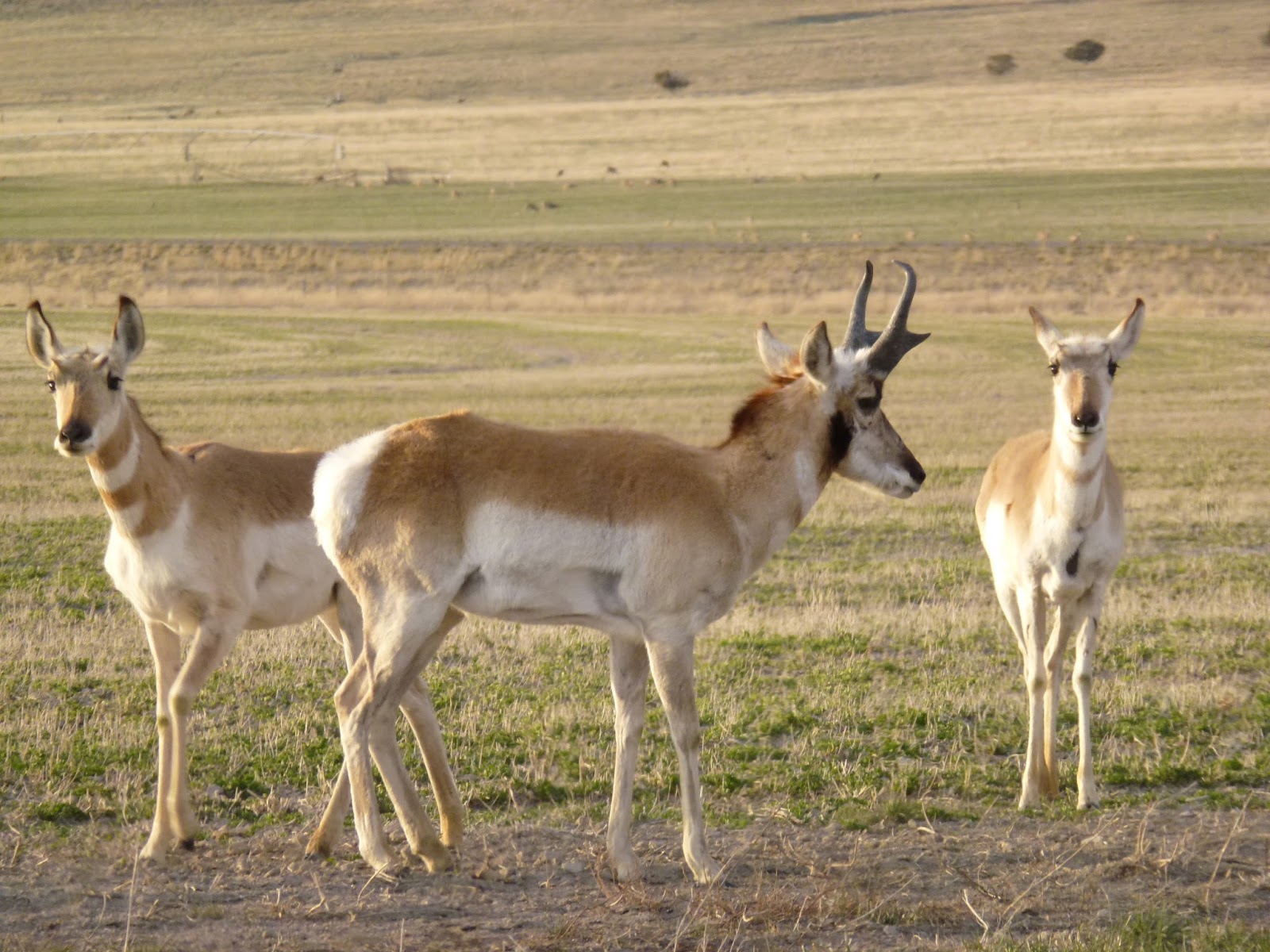
Pronghorn Antelope
Continuing east on I-84 we started to see Pronghorn Antelope on the side of the road.  We crossed into Utah and drove to the Great Salt Lake, where we intended to spend some time birding the next day.  We laid out our bedrolls on a sandy beach and enjoyed the moonlit night.  The next morning we got up early and drove to Antelope Island State Park, which is in the middle of the Great Salt Lake but is connected to the mainland by a causeway.  The birding was amazing and we even saw a few Bison and Pronghorn.


Massive clusters of Siberian Elm (Ulmus pumila) samara
By mid-afternoon the birding had slowed down, so we left the Island.  While at a gas station I noticed some Siberian Elm (Ulmus pumila) trees that were just loaded with edible samara (winged seeds).  They were in the peak of their season and I munched several handfuls.  When still green, elm samaras make an amazing addition to salads.  They have a flavor and texture that is like a cross between spinach and oatmeal.  They are a very common street tree and we saw them planted abundantly throughout Salt Lake City, Eastern Utah, Boulder and Denver Colorado, as well as Yakima, WA.  They aren’t as common in Western WA, but they are definitely around.  If you haven’t tried Elm samara (particularly Siberian Elm), I highly recommend them, they are one of my favorite salad greens.

After collecting a small stash of samara, we climbed into the Wasatch Mountains and followed HWY 40 into the Uinta Mountains to Starvation State Park in eastern Utah.  The park surrounds a reservoir of the dammed Strawberry River and is made up of exceedingly beautiful red sandstone, dry Juniper and Agave scrublands, and nice sandy pocket beaches.  The tremolo call of loons lulled us to sleep as the stars twinkled through the thin atmosphere.  We rose early the next morning to find the tracks of a coyote who had circled us as we slept.

Rising early in a world full of mystery


Ponderosa berries
We continue east along HWY 40 as the day began to warm and come to life.  Our next stop was Dinosaur National Monument where we saw some amazing Allosaurus fossils.  The Allosaurus were a similar size and shape as the T-Rex, but lived almost 100 million years earlier.  We also saw some spectacular petroglyphs, mountain bluebirds, and colorful spring wildflowers.  That night we camped near Kremmling CO, at the base of the Rockies and near the headwaters of the Colorado River.  Only a short drive from Boulder, the next day we took back roads through the mountains and enjoyed the scenery.  I optimistically tried the young cones of Ponderosa Pine (Pinus ponderosa).  Last year, ethnobotanist Nancy Turner told me that young Whitebark Pine (Pinus albicaulis) cones could be eaten, so I thought it was worth experimenting with the cones of Ponderosa Pine.  They were no bigger than an inch long and ¾ of an inch wide and required a bit of twisting to remove them from the branch.  Raw, I found them to be more tender than I expected and milder than Juniper berries, but still very resin flavored.  Boiling for 5 minutes softened them further, but they still were too resinous to enjoy more than one.

That evening we met Katrina’s brother Derek in Boulder, who kindly put us up for the evening, and the next day we drove to the Denver Botanic Gardens for the Society of Ethnobiology Conference.
Pin It submit to reddit